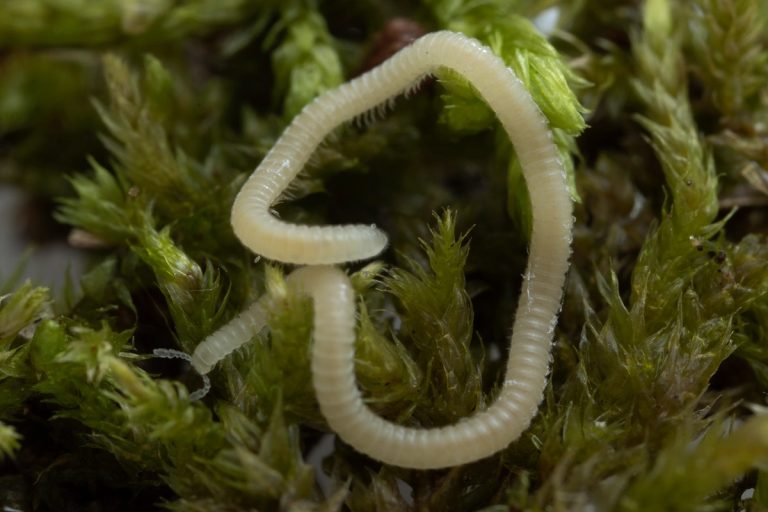
Los Angeles, known for its bustling freeways and traffic, recently witnessed the unearthing of a newfound species, aptly named the Los Angeles Thread Millipede. This tiny arthropod was discovered by naturalists in a Southern California hiking area, located in close proximity to a freeway, a Starbucks, and an Oakley sunglasses store.
Resembling a translucent and sinuous jellyfish tentacle, this millipede is as long as a paperclip but slender like pencil lead. It navigates its way four inches below the ground using hornlike antennas on its head, as it is blind and relies on these sensory organs to find its path. Under the microscope, the creature’s helmet-like head and 486 legs conjure images from a Hollywood monster film.
The research team, comprising scientists from the Virginia Polytechnic Institute, West Virginia University, and the University of California, Berkeley, published their findings on this species, scientifically known as Illacme socal, in the journal ZooKeys on June 21. The Los Angeles Thread Millipede, as it is colloquially known, serves as a testament to the existence of an unexplored world beneath the surface.
Interestingly, California is home to various other millipede species, including the former record-holder for the highest number of legs, boasting an astounding 750 limbs. This species, named Illacme plenipes, was discovered in Northern California in 1926. However, in 2021, a millipede with a staggering 1,306 legs was found in Australia, dethroning the Californian creature.
Millipedes play a crucial role in the ecosystem by feeding on dead organic matter. Without their invaluable contribution, the environment would be overwhelmed with waste. Understanding these species and their ecological significance can aid in their protection, ensuring a balance in nature that ultimately benefits human beings as well.

The discovery of the Los Angeles Thread Millipede owes much to modern tools like the iNaturalist app, which allows citizen naturalists to participate actively in scientific research. In this case, naturalists Cedric Lee and James Bailey stumbled upon the creature while collecting slugs at Whiting Ranch Wilderness Park in nearby Orange County. DNA sequencing and analysis confirmed that it was, indeed, a new species.
Lee, a doctoral student at UC Berkeley, has been a prominent figure in discovering and documenting thirty centipede species in California. He emphasizes that microorganisms are often overlooked in the search for new species and advocates for citizen science as a vital link between the natural world and scientific investigation.
Despite the vast array of known species on Earth, scientists estimate that millions remain undiscovered. Brian Brown, curator of entomology at the Natural History Museum of Los Angeles County, highlights that our knowledge of insect species and small creatures worldwide is limited. Brown’s extensive research project, BioSCAN, revealed that Los Angeles alone is inhabited by approximately 20,000 species of insects, both known and unknown.
You can also read: Minneapolis Security Guard Fired for Requesting Fan Photos with Taylor Swift
However, the increasing threats posed by climate change and invasive species endanger native species, making conservation efforts more critical than ever. Daniel Gluesenkamp, president of the California Institute for Biodiversity, cites the Los Angeles Thread Millipede as a prime example of the vast unexplored frontier that demands attention. To safeguard these ecosystems, Gluesenkamp advocates for investments in local parks and preservation of any remaining wild areas, no matter how small, to protect and harness them as potential solutions in the face of challenging times ahead.