A groundbreaking discovery has been made by scientists who recently unearthed fossilized remains of a previously unknown species of duck-billed dinosaur in Chile. The dinosaur, named Gonkoken Nanoi, existed approximately 72 million years ago and was a herbivorous creature weighing around one tonne. It could grow up to an impressive length of 4 meters (13 feet), as reported in a study published in Science Advances.
The findings were the result of an expedition led by the Chilean Antarctic Institute (INACH) in 2013. Fragments of yellowish bones were discovered at the base of a hill near the renowned Torres del Paine national park in Patagonia.
Jhonathan Alarcon, the lead author of the study, expressed their initial belief that the bones belonged to the same group as other South American hadrosaurs. However, as the research progressed, it became evident that the fossils represented something entirely new and unprecedented.
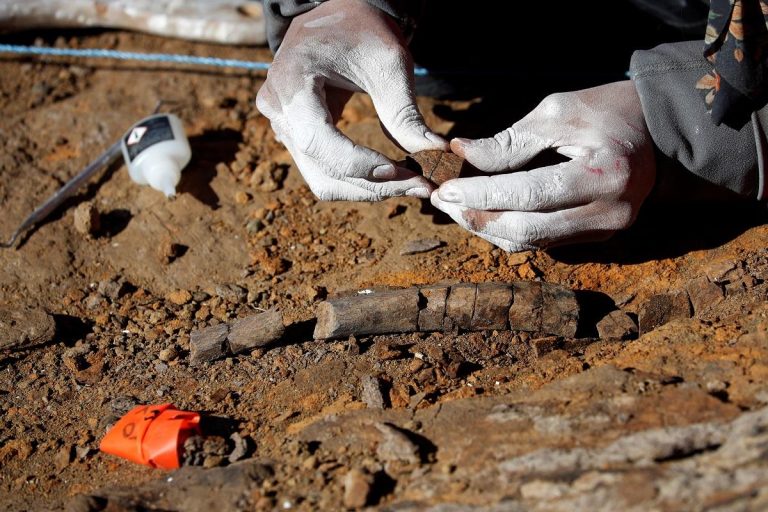
With great care, the researchers delicately extracted over 100 bone fragments, ensuring the preservation of the fossils and avoiding damage to other remains. Subsequently, palaeontologists undertook the task of confirming the identification of the remains as belonging to the same species. They cross-referenced the findings with existing research to establish that Gonkoken Nanoi was indeed a previously unknown type of dinosaur.
You may also read: Stunning Dinosaur Embryo Discovered Inside Fossilized Dinosaur Egg
Alexander Vargas, another author of the study, clarified that Gonkoken Nanoi did not belong to an advanced duck-billed dinosaur category but rather represented an older transitional lineage. This dinosaur species served as a crucial evolutionary link to the more advanced forms of duck-billed dinosaurs.