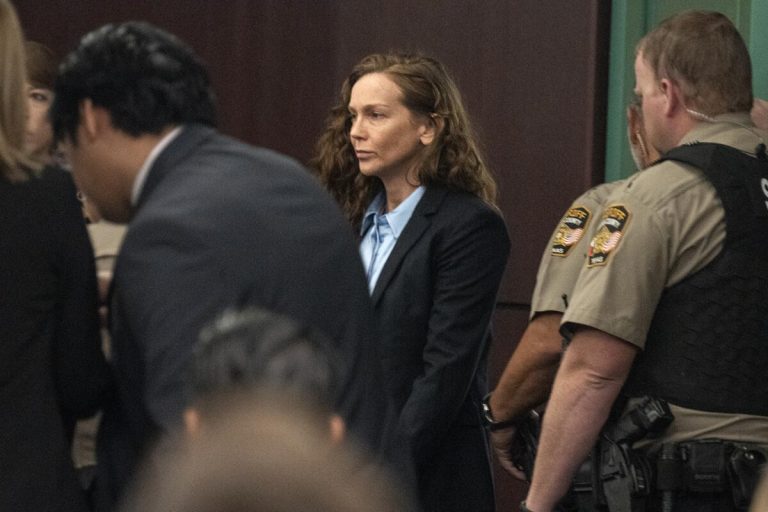
In a murder trial that began with gripping opening statements, it was revealed that a Texas woman charged with the killing of professional cyclist Moriah “Mo” Wilson had allegedly tracked her victim’s movements on the exercise app Strava before stopping her car near the Austin apartment where Wilson was residing and fatally shooting her.
Kaitlin Armstrong, 35, has pleaded not guilty to the murder of Wilson, a 25-year-old rising star in gravel and mountain bike racing. Both Armstrong and Wilson had been romantically linked to the same man. Wilson’s body was discovered with multiple gunshot wounds at a friend’s Austin home in May 2022. Armstrong fled the country with a fraudulent passport a week later, only to be apprehended at a hostel in Costa Rica in June 2022 and extradited back to the United States. If convicted, Armstrong could face a prison sentence of up to 99 years. Prosecutors have opted not to seek the death penalty in this case.
The trial’s opening statements painted a harrowing picture of the events leading up to the murder. Wilson had traveled to Austin in May 2022 to participate in a race in Hico, located southwest of Fort Worth. There, professional cyclist Colin Strickland, who had briefly dated Wilson in the fall of 2021 during a short break in his relationship with Armstrong, arranged to meet with Wilson. On the fateful day of May 11, Wilson and Strickland spent time together, going for a swim at a local pool and having dinner. According to prosecutors, Strickland lied to Armstrong about his whereabouts, as indicated in a police affidavit.
Prosecutors argued that Armstrong had access to Strickland’s messages through a shared laptop at their residence, enabling her to ascertain Wilson’s location based on data from Wilson’s earlier bike ride, which had been posted on Strava.
Later that evening, security cameras near the apartment where Wilson was staying captured her screams, followed by two gunshots, as described by prosecutor Rickey Jones. The casings from those gunshots were allegedly a match for Armstrong’s 9mm Sig Sauer handgun. Additionally, Armstrong’s vehicle, prosecutors contended, resembled the black SUV seen in security footage near Wilson’s apartment that night, and Armstrong couldn’t provide a reasonable explanation for its presence in the area, according to a police affidavit.
In her defense, attorney Geoffrey Puryear argued that the case against Armstrong lacked concrete evidence and suggested that law enforcement had a biased focus on implicating Armstrong. He portrayed Armstrong as trapped in a “nightmare” of circumstantial evidence and pointed out the absence of any witnesses who could attest to her involvement in the murder.
Following the opening statements, the prosecution presented its first two witnesses: Wilson’s brother, Matthew, and Caitlin Cash, the friend at whose apartment Wilson was staying when she was killed. Cash became visibly emotional on the witness stand as she described discovering Wilson’s lifeless body and the 911 call she made that day.

You can also read: “Freak Accident” Claims Life of Ice Hockey Player Adam Johnson
The trial commenced only two weeks after Armstrong’s attempted escape from jail during transport to a doctor’s appointment. As officers escorted her, she made a brief dash, injuring an officer in the process. Armstrong now faces an additional charge of escape causing bodily injury, ruled admissible as part of the prosecution’s case against her.
The trial is expected to span approximately two weeks.