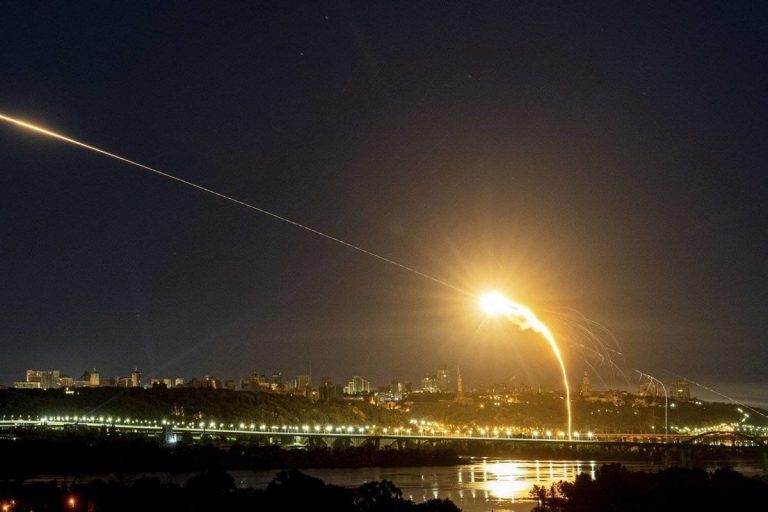
In a recent development, Russian forces launched a series of nocturnal drone and missile attacks targeting 10 out of Ukraine’s 24 regions. Ukrainian authorities, anticipating another season of infrastructure destruction at the hands of the Kremlin, reported these incidents. The Ukrainian air force successfully intercepted 24 out of 38 Shahed drones and a Kh-59 cruise missile launched by Russia. The attacks resulted in fires in residential and public structures, particularly in the Kherson region, which has increasingly become a focal point of Moscow’s aggression in recent weeks. Two individuals were injured as a result of these strikes.
Ukraine’s President, Volodymyr Zelenskyy, conveyed his concern about the approaching winter, warning of potential efforts by Russian forces to inflict further damage. Last winter, Russia targeted Ukraine’s power grid in an attempt to deprive civilians of essential utilities, such as electricity and heating, undermining the country’s resolve in the ongoing conflict. Ukrainian officials accused the Kremlin of weaponizing the harsh winter conditions.
Ramesh Rajasingham, the Coordination Director at the U.N. humanitarian office, stated that the Russian strikes were causing “unprecedented suffering” among Ukrainian civilians. Andriy Yermak, the President’s chief of staff, highlighted that Russia had expanded its use of drones in nighttime attacks as winter neared, emphasizing the importance of control over the airspace.
Laser-guided munitions designed to counter drones are expected to be part of a $425 million package of new military aid from the United States to Ukraine, according to U.S. officials.
With the approaching wet, muddy, and cold weather, both sides are likely to face challenges in advancing on the battlefield, potentially necessitating a shift in military strategies. Analysts predict that Russia and Ukraine will stockpile ammunition in preparation for offensives in 2024. Ukraine relies heavily on support from its Western allies and plans to boost its domestic weapons production, while Russia is reportedly obtaining supplies from North Korea, Iran, and Belarus.

On the ground, both armies are grappling with difficulties in making substantial progress along the 1,500-kilometer front line, primarily characterized by artillery exchanges. Gen. Valerii Zaluzhnyi, Ukraine’s commander-in-chief, noted that artillery, missiles, and rockets constitute up to 80% of all military activities.
You can also read: “Freak Accident” Claims Life of Ice Hockey Player Adam Johnson
Ukraine’s capabilities have been enhanced by the use of U.S. long-range ballistic missiles, such as ATACMS, and U.K. long-range Storm Shadow cruise missiles to target Russian logistics and command centers behind the front lines. Furthermore, the planned delivery of F-16 fighter jets to Ukraine in the early part of next year is expected to bolster Kyiv’s military strength, providing air cover for its ongoing counteroffensive against Russian forces.