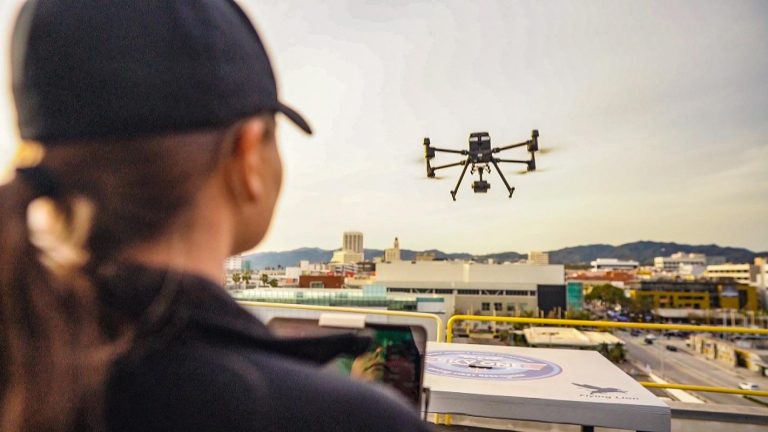
In the upscale beach town of Santa Monica, California, a new approach to policing has taken flight. When a 911 call is made for police assistance, a drone is swiftly dispatched from the local station, often arriving at the scene before officers. This technological advancement has been hailed as a game-changer in law enforcement.
Peter Lashley, a seasoned police officer who frequently operates the drone from a command center at the station, describes it as a fundamental shift in the delivery of policing services. Equipped with a powerful camera, the drone provides a comprehensive view of the area, capable of zooming in to read license plates or capturing footage of several square blocks. In one notable instance, the drone’s camera served as the sole witness to a brutal robbery, leading to the apprehension and conviction of one suspect. Moreover, on multiple occasions, it provided crucial information to responding officers, revealing that subjects believed to be armed were, in fact, carrying fake firearms. This knowledge allowed the officers to respond with less aggression, defusing potentially violent situations.
At a time when law enforcement agencies face challenges to their legitimacy due to high-profile cases of officer-involved killings, drones offer the potential to de-escalate encounters and promote safer outcomes. However, concerns about privacy and the balance of power between citizens and the government inevitably arise.
In Southern California, where the “drones as first responder” program was first implemented in 2018 in Chula Vista, support from residents and political leaders has been strong. This support stems from the understanding that the drones are not used for indiscriminate surveillance of neighborhoods. Blanket aerial police surveillance across an entire city has been deemed unconstitutional by the courts. Instead, the drones are deployed in response to specific 911 calls for service.
The use of drones to respond to emergency calls is a relatively new and rare practice in law enforcement. The program has gained traction in the Los Angeles area, with cities like Beverly Hills and Redondo Beach joining Santa Monica in adopting the initiative. However, the Los Angeles Police Department, which operates a fleet of helicopters, has not incorporated drones into their 911 response system, although they utilize them selectively in tactical situations.
The development of tactical drone technology is also expanding. A prime example is the Lemur, a robust quadcopter capable of breaking glass, opening doors, and entering buildings, enabling police to communicate with barricaded subjects in hostage scenarios. Although Santa Monica has not yet employed the Lemur, many other departments have embraced this advanced tool.
Addressing privacy concerns, police departments have implemented safeguards to protect citizens’ rights. Operators are forbidden from recording video over private residences or areas where individuals have a reasonable expectation of privacy, unless it is necessary in emergencies or under a valid warrant. Some departments, like Chula Vista, even publish the flight paths of every drone mission on their websites. Santa Monica authorities ensure the destruction of all video footage after 60 days, except in cases where it is required as evidence or for ongoing investigations.
In response to inquiries or concerns, police departments have informally shown drone camera footage to interested parties. However, California departments maintain that this video is not subject to release under public records laws, a stance currently being challenged in a lawsuit against Chula Vista by a bilingual Latino newspaper, La Prensa San Diego.
While the persistent surveillance capabilities of drones could greatly assist in solving street crimes, especially in communities where witnesses are reluctant to cooperate, the extensive collection of data on individuals’ movements raises valid concerns about privacy invasion. Courts have already ruled that such broad surveillance constitutes an unacceptable infringement on privacy rights. In Baltimore, a program using planes equipped with cameras for persistent aerial surveillance was declared unconstitutional.
Responding to emergency calls with drones poses fewer constitutional concerns, as experts argue that the greatest benefit lies in enhanced situational awareness for officers. By providing real-time information, experienced police officers can better inform responding units about the nature of the situation, offering valuable insights beyond what can be gleaned from a phone call alone.
In Chula Vista, drone operators listen in on 911 calls and deploy the aircraft based on information obtained during those calls, often even before police are dispatched to the scene. This approach ensures that officers have a more informed perspective when they arrive, improving their decision-making and potentially reducing the chances of overreactions.
Fire departments also leverage the capabilities of drones that respond to 911 calls. These drones aid in better understanding fires and incidents involving hazardous materials, facilitating more effective emergency responses.

DJI, the leading brand for consumer and commercial drones, is often mentioned in discussions about police drones. However, the company, which is Chinese-owned, was blacklisted by the U.S. Defense Department due to concerns that data from their drones could be shared with the Chinese government. DJI denies posing any threat and continues to be used by state and local governments in the United States.
You can also read: Gunman in Philadelphia Kills Five and Injures Two Children
In conclusion, drones have introduced a transformative element to law enforcement in Santa Monica and other cities. By providing critical information, de-escalating situations, and enhancing officer safety, drones have the potential to revolutionize policing practices. However, striking the balance between public safety and privacy remains an ongoing challenge that requires careful consideration and robust regulations.