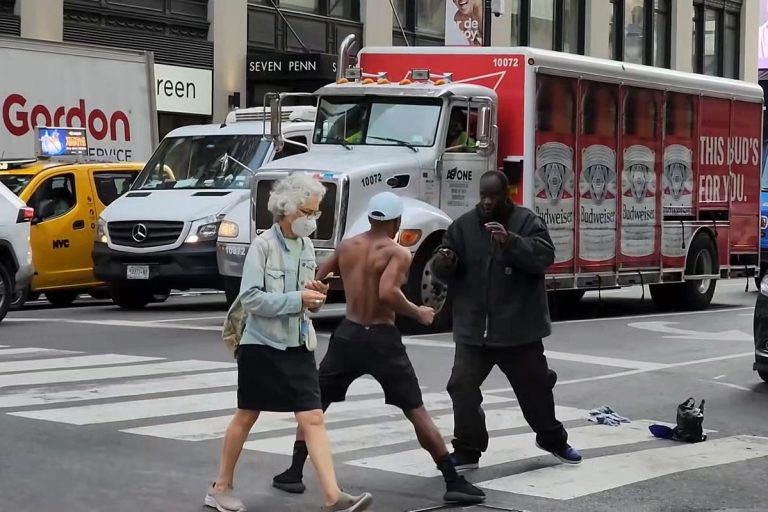
Last week, New Yorkers witnessed a disturbing event that left them questioning the livability of their city. It wasn’t the usual sight of wildfire smoke turning the sky orange across New York; instead, it was a slow-motion murder unfolding in a Manhattan crosswalk during rush hour, while passersby went about their day.
The incident took place at Seventh Avenue and 30th Street in New York, a busy commuting corridor between Penn Station and Chelsea’s tech offices. Two men in their thirties engaged in a physical altercation, bringing traffic to a halt as they moved into the crosswalk. What ensued was like a scene from an MMA fight in the middle of the avenue, with one of the men brandishing a small knife.
Amidst this surreal scene, pedestrians continued to cross the street, seemingly unaffected by the violence. A woman in professional attire, meticulously dressed with a K95 mask and perfectly styled hair, crossed the path of one of the combatants. She offered a quick, furtive glance back at the men but kept her head down and hastened her pace.
Another individual in business-casual attire swiftly walked past, avoiding any direct engagement. On the sidewalk, a man in an orange sweatshirt casually observed the unfolding altercation. Even a woman in medical scrubs, who stopped briefly to intervene, eventually moved on when her efforts failed.
Tragically, within seconds, one of the men succumbed to his injuries and bled out in the crosswalk. The other participant, identified as Nisean Graves, 34, who the police claim provoked the fight, now faces murder charges.
The contradictory behavior exhibited by both men is perplexing. Graves, clearly displaying a level of frenzy that led to a fatal stabbing in broad daylight, demonstrated enough presence of mind to watch out for oncoming traffic and pause his attack for the safety of pedestrians. The victim, a 36-year-old still unidentified by the police but reportedly wanted for a murder in Baltimore, had several opportunities to escape but chose to confront his opponent despite the knife pointed at him.
The question arises: How could New York City have prevented this murder when neither the alleged killer nor the victim attempted to de-escalate the situation, despite ample time, opportunity, and motive?
The failure of the criminal justice system in New York is evident in this case. Graves had only recently completed a one-year prison sentence for repeatedly stabbing someone in Manhattan. Additionally, the concept of “eyes on the street” safety, which is meant to prevent such incidents in crowded areas, fell short in this instance.
Advocates of bystander intervention may wonder why others did not step in to defuse the situation. While a woman in medical scrubs did make an attempt, it proved unsuccessful, leading her to move on. It is understandable that others refrained from involvement, as the fear of personal harm or the potential backlash from intervening can be discouraging. Threatening to call 911 or intervening in a physical altercation can sometimes result in injury or even accusations of overreacting and using unnecessary force.
Furthermore, there is a prevailing narrative that downplays the severity of crime in the city. Despite evidence to the contrary, progressives insist that crime rates are low. However, in the area where this murder occurred, Midtown South, there have been 17 murders since 2020, surpassing the number recorded in the previous nine years. This incident is the second brazen daylight murder in the area this year, with another occurring during the afternoon commute.
Major felony crimes citywide have reached levels nearing 20-year records, standing at 42% higher than in 2019 as of mid-May. Despite these alarming statistics, there are those who dismiss the reality of the situation and choose to walk on, treating potential future crime victims as invisible ghosts, even when they are just an arm’s reach away.
You can also read: Video Exposes Police Officer’s Brutal Assault on 19-Year-old Prisoner
The incident in New York City raises significant concerns about safety and the need for intervention in similar situations. It calls for a comprehensive review of the criminal justice system and a reassessment of societal attitudes towards bystander involvement. Recognizing and addressing the escalating crime rates is crucial to ensuring the well-being and security of all residents and visitors to the city.