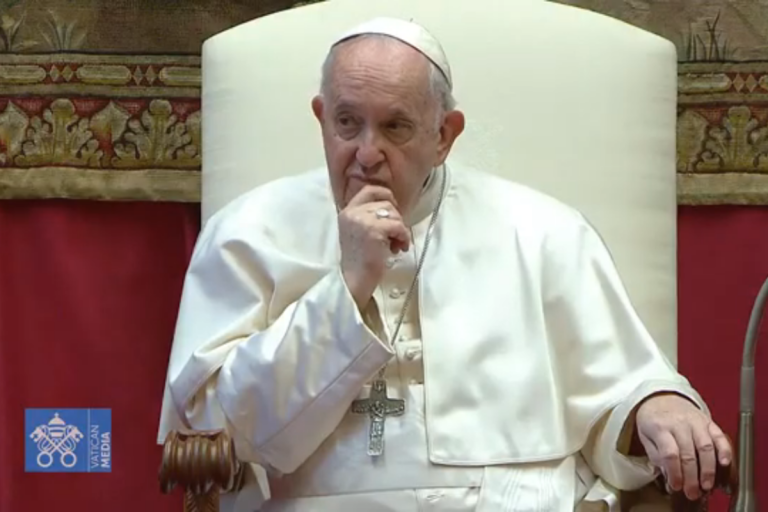
Pope Francis’ “state of the world” address was given on Monday to diplomats accredited to the Vatican. It typically lists the topics that the Holy See is most worried about.
Watch the full 2023 State of the World Address given by Pope Francis below:
He used a cane to get into the large Hall of Blessings on top of St. Peter’s Basilica, which is a sign that his long-term knee pain may be getting better.
Along with the European Union and the Sovereign Order of Malta, the Vatican maintains diplomatic ties with 183 other countries.
In his annual message to ambassadors, Pope Francis criticized a number of things, such as how Iran treats protesters, Russia’s war in Ukraine, and how supporters of Brazil‘s far-right ex-president destroyed government buildings.
Pope Francis denounced the “third world war,” which “implicate just certain sections of the planet directly, but in fact involve them all,” as he recalled the various current wars across the world.
The pope spoke directly about the fighting in Ukraine and called for an end to the “senseless strife” right away.
He emphasized the major issues that are affecting everyone in the world today, with the conflict in Ukraine and the “trail of death and ruin” it has left behind, with people passing away not just from explosives but from being hungry and the cold.
Pope Francis urged political leaders to protect the rights of the most vulnerable and fight the throwaway culture that tragically affects the sick, the disabled, and the elderly. He also said that it is the government’s primary responsibility to make sure that citizens are helped in every stage of human life until natural death.
“Building peace requires that there be no place for violation of the freedom, integrity and security of other nations.”
Images: Pope Francis greets members of the diplomatic corps accredited to the Holy See for the annual exchange of New Year greetings.https://t.co/5ABQnpNXrF pic.twitter.com/3wTNXArlwW
— Vatican News (@VaticanNews) January 9, 2023
Then, he also spoke of Israelis and Palestinians about their conflicts, Iran’s death penalty, the banning of women from school in Afghanistan, as well as political and social unrest in Brazil, Peru, and Haiti.
He also focused on a number of global issues, including the crisis in Lebanon; the migratory catastrophe that has turned the Mediterranean into a cemetery.; and the fighting in the South Caucasus that has left populations grappling with deadly landmines in Syria and Yemen.
Additionally, the pope urged increased international cooperation in three areas of public policy: immigration, the economy and employment, and environmental protection.
Pope Francis also mentioned the Holy See and China’s agreement to prolong their interim agreement for the appointment of bishops in the nation for an additional two years when outlining the Vatican’s diplomatic accomplishments in 2022. The agreement, which was initially inked in 2018, does not have any public terms.
The Pope’s trip to the Democratic Republic of the Congo at the end of the month as a “pilgrim of peace,” followed by a joint trip to South Sudan with the Canterbury Archbishop and the Presbyterian Church of Scotland’s leader, will be the next big milestone in his diplomatic career.