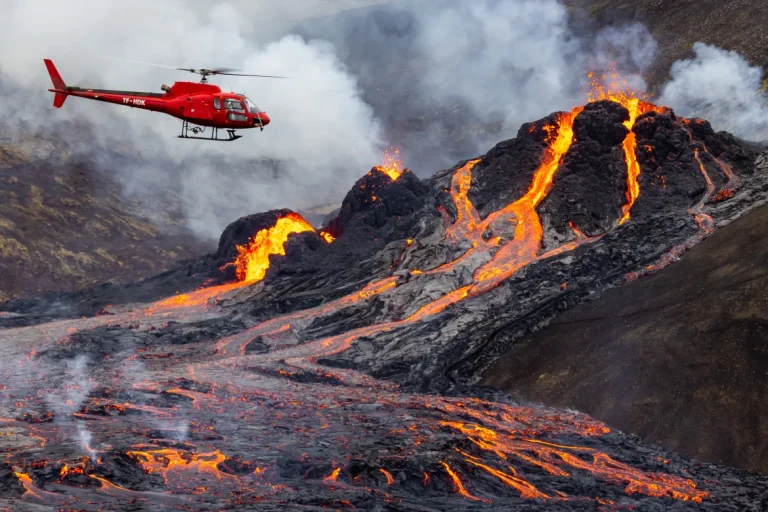
A volcanic eruption that commenced on Monday in Iceland persisted in spewing lava on Tuesday, accompanied by hundreds of earthquakes along the magma flow on the country’s southwestern coast, as reported by officials.
According to Iceland’s Meteorological Office, the volcanic activity in Sundhnúksgígar on the Reykjanes Peninsula appeared to be waning. New aerial images analyzed on Tuesday revealed three vents emitting lava southeast of Stóra-Skógfell, down from five at the eruption’s onset in the Fagradalsfjall volcanic system.
“The lava flow is estimated to be about one-quarter of what it was at the beginning of the eruption,” stated the Meteorological Office in a Tuesday statement.
On Tuesday, a third of the original fissure, measuring 2 1/5 miles long, remained active, with lava fountains reaching about 30 meters (approximately 100 feet) at their highest, lower than the eruption’s initial stages, the Meteorological Office reported.
Since the volcano erupted on Monday night, at least 320 earthquakes, one measuring a magnitude of 4.1, have occurred, but seismic activity in the area has significantly decreased since then. Only 10 earthquakes were recorded in the region since noon on Tuesday, according to officials.
Following the eruption in Sundhnúksgígar, the land around the Svartsengi power station, a geothermal power plant, sank about 5 centimeters (approximately 2 inches), officials stated. Prior to the eruption, the land had risen by about 35 centimeters (roughly 14 inches) due to the magma channel that had been building since November 10.
“It is too early to determine if magma will continue to accumulate under Svartsengi and whether the land will start to rise again,” cautioned the Meteorological Office.
The eruption, north of the town of Grindavik, began at around 10 p.m. local time on Monday, with an “earthquake swarm” preceding it, according to the Meteorological Office. The affected area near Grindavík, a town evacuated in November, remains closed off.
While the eruption persists, there is an increased likelihood that more vents may open along the original fissure or further north or south, officials warned. Looking back at the lead-up to the eruption, the Meteorological Office noted that there were approximately 90 minutes between the first indicators and the eruption’s commencement.
The eruption, situated on “the dyke intrusion that formed in November,” began expanding southward, with the southern end near Sundhnúkur, officials explained. Scientists estimated the lava discharge to be “hundreds of cubic meters per second,” and the largest lava fountains were observed on the northern end.
View this post on Instagram

You can also read: Mystery Surrounds Arizona House Fire Claiming 5 Lives, Including 3 Children
Local weather officials had previously warned of a “significant likelihood” of a volcanic eruption in November. A state of emergency had been declared in the sparsely populated Reykjanes Peninsula near Mount Fagradalsfjall due to more than 20,000 earthquakes in the area since late October.