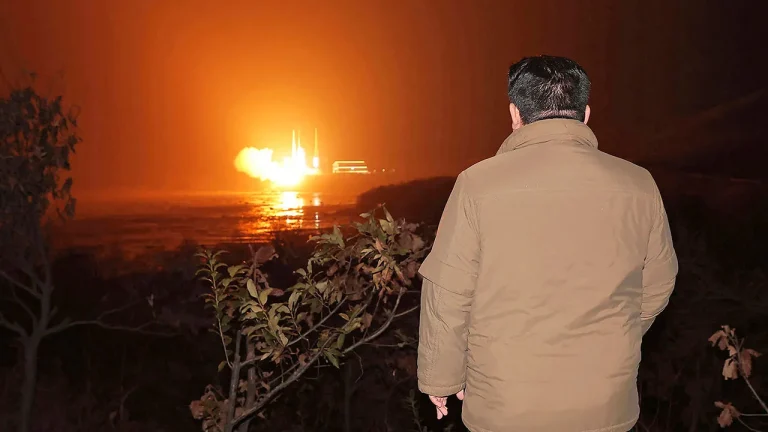
North Korea, after enduring years of foreign surveillance, has entered the space arena with the launch of its inaugural spy satellite, signaling its capability to observe global activities. According to reports from North Korean state media on Tuesday, leader Kim Jong Un examined satellite images capturing the White House, Pentagon, and U.S. aircraft carriers stationed at Norfolk’s naval base.
The recently launched reconnaissance satellite, purportedly designed to monitor U.S. and South Korean military movements, has since been reported to have photographed various locations, including cities and military bases in South Korea, Guam, Italy, and the United States.
Chad O’Carroll, founder of the North Korea-focused website NK News, likened the situation to the excitement of receiving a coveted toy at Christmas, highlighting the enthusiastic tone in the state media reports.
Despite the claims, Pyongyang has yet to release any imagery, prompting analysts and foreign governments to question the actual capabilities of the new satellite. South Korea, facing a delay in the launch of its own spy satellite due to weather conditions, has expressed skepticism about the verifiability of North Korea’s satellite capabilities.
Satellite imagery expert Dave Schmerler noted that while there is no reason to doubt the satellite’s ability to capture large areas or warships, the usefulness of the images depends on the intended purpose. For these satellites to be effective in a conflict scenario, North Korea would need to launch more satellites to increase the frequency of passes over key sites—an objective the North’s space agency claims to pursue.
Jeffrey Lewis, a researcher at the James Martin Center for Nonproliferation Studies, suggested that a state media photo of Kim examining satellite images with his daughter implies the use of panchromatic imagery, a black-and-white photography type sensitive to all wavelengths of visible light.

You can also read: Unrest Unleashes in Dublin Following Stabbing of Young Children
The released images of “major target regions” included satellite photos of Andersen Air Force Base in Guam and a U.S. shipyard and airbase in Norfolk and Newport. The United States and South Korea, however, have condemned the satellite launch, citing a violation of U.N. Security Council resolutions prohibiting the use of ballistic technology. The international community continues to await concrete evidence of the satellite’s capabilities and its intended applications.